Six decades. One conviction. From the paddy-soaked fields of Central Travancore to the floor of the Kerala Assembly — the story of the Kerala Congress (M) is the story of the farmer, the worker and the common citizen of Kerala.
In the early 1960s, Central Travancore was a quilt of paddy fields, rubber estates and small church-town parishes. Smallholding farmers and the workers on their land lived a shared rhythm — monsoon, harvest, festival, debt. Politics in Thiruvananthapuram, however, did not listen to them. Their crops, their cooperatives, their schools and their dignity were footnotes in someone else's manifesto.
Out of that silence, a new political conscience was being shaped — one that would refuse to treat the man with five acres of paddy and the man who worked them as enemies.
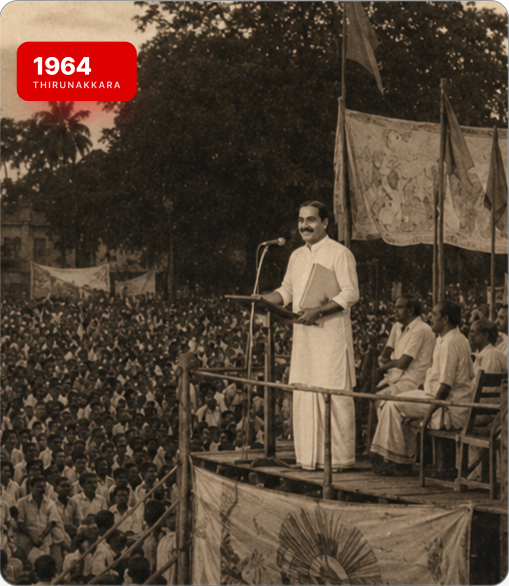
On 9 October 1964, before thousands of farmers, traders and Sabha-members at the Thirunakkara Maidan in Kottayam, the new Kerala Congress was inaugurated by Bharathakesari Mannathu Padmanabhan, the legendary NSS leader.
It was founded by K. M. George and R. Balakrishna Pillai together with about fifteen ex-Congress MLAs who had broken away from the KPCC in protest at the anti-farmer, anti-democratic drift of the Indian National Congress. The trigger was the death of Home Minister P. T. Chacko and the no-confidence motion that toppled the R. Sankar ministry.
In the very next year, 1965, the new party walked into the Kerala Assembly with roughly 25 seats. Among the first-time MLAs who joined the party that year — a thirty-two-year-old lawyer from Pala named K. M. Mani.
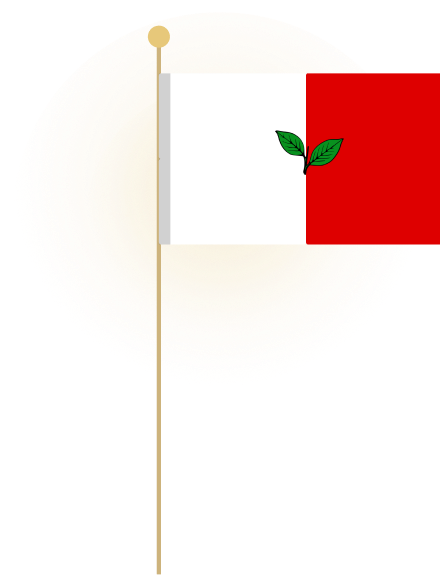
White at the top. Red at the bottom. Equal in size and proportion. Peace and harmony above, the toil and sacrifice of the working people below — and at its heart, the two leaves of a movement rooted in soil and in service.
Scroll The flag rises
Adhvana Varga Sidhantham · അദ്ധ്വാന വർഗ്ഗ സിദ്ധാന്തം
At a state committee meeting on the hilltop of Charalkkunnu on 27–28 March 1978, K. M. Mani gave the party — and Kerala's politics — a new vocabulary. Building on the Aluva Economic Resolution of 1973 at the Aroma Auditorium, he inverted the orthodox left–right split of farmer-versus-worker and placed them on the same side of one moral line.
Farmers, agricultural workers, factory hands and salaried employees all belong to the same toiling class. Their interests are aligned, not opposed.
A farmer and the worker on his field share the same dignity of labour. The party that fights for one must fight for the other.
K. M. Mani gave the theory its formal shape on 27–28 March 1978, building on the 1973 Aluva Economic Resolution. It was later presented at the British Parliament.
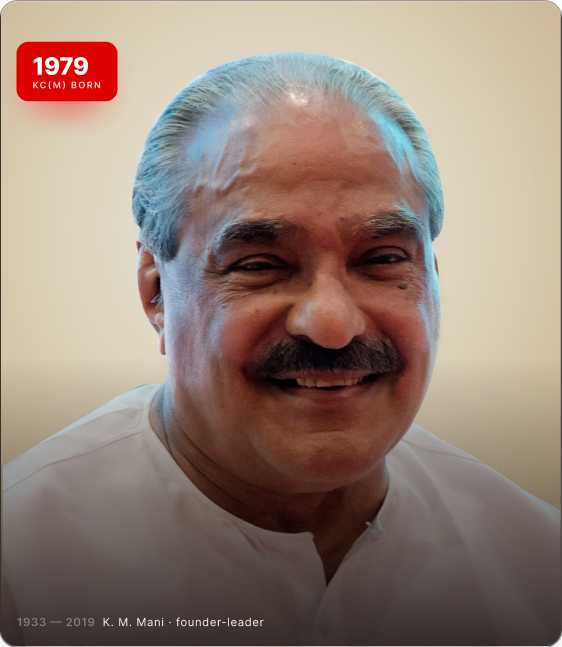
By the late 1970s the parent Kerala Congress had begun to fracture. K. M. George had died in 1976; R. Balakrishna Pillai had already left in 1977. In 1979, after a split from P. J. Joseph's faction, K. M. Mani led the formation of Kerala Congress (Mani) — the party we know today as Kerala Congress (M).
The bracketed letter was not a label of vanity. It was a promise of identity: a Kerala Congress whose centre of gravity would remain with the farmer, the worker and the toiling class, and whose founder would lead it for the rest of his life.
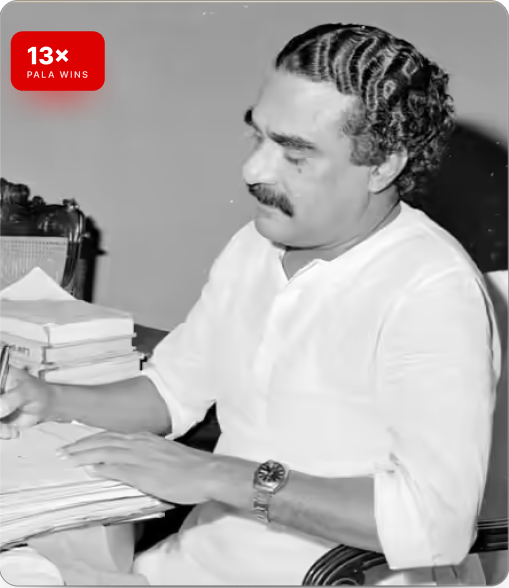
From 1965 to 2016, the people of Pala sent K. M. Mani to the Kerala Assembly thirteen consecutive times. No legislator in Kerala's history has matched that mandate. The Pala mandate was not a personal cult — it was a contract: send him to Thiruvananthapuram, and he will send the budget back to the farmer.
He kept the bargain. Across the 1980s, 1990s, 2000s and 2010s — through multiple ministries — Mani held the Finance portfolio and rose to present thirteen state budgets, more than any Finance Minister in Indian state history.
"There is one Kerala Congress in this country. That is our Kerala Congress (M)."— K. M. MANI
Kerala Congress (M) was never the biggest party in the room. It did not need to be. For four decades, in coalition after coalition, KC(M) held the balance — converting a tightly disciplined block of MLAs into ministries, budgets, and welfare schemes that the larger fronts could not deliver on their own.
The most enduring of those schemes is the Karunya Benevolent Lottery, designed by K. M. Mani to fund treatment for poor patients fighting cancer, kidney disease and other catastrophic illnesses — a welfare instrument with the language of the Toiling Class baked into it.
On 9 April 2019, K. M. Mani passed away at Lakeshore Hospital, Kochi. Two months later, on 16 June 2019, at a state committee meeting at the CMS Retreat Center, Kottayam, his son Jose K. Mani was selected as the new Chairman of the Kerala Congress (M). The succession was later confirmed by the Election Commission of India and upheld by the Supreme Court.
On 30 June 2020, after a long dispute over the Kottayam District Panchayat presidency, the party left the United Democratic Front. In October 2020, the Kerala Congress (M) joined the Left Democratic Front. It was the most significant realignment in the party's history since 1979 — and a return, in the party's own framing, to the toiling-class language with which it began.

A senior partner of the United Democratic Front for almost four decades — from December 1981 to June 2020.
Joined the Left Democratic Front. Contested the 2020 panchayat polls and the 2021 Assembly election as an LDF constituent.
The decision was not without cost. In the 2021 Assembly election, KC(M) contested twelve seats and won five — and Chairman Jose K. Mani himself lost Pala to Mani C. Kappan by 15,378 votes. But Roshy Augustine entered the Pinarayi Vijayan cabinet as Minister for Water Resources, and N. Jayaraj was named Government Chief Whip. The journey continues.
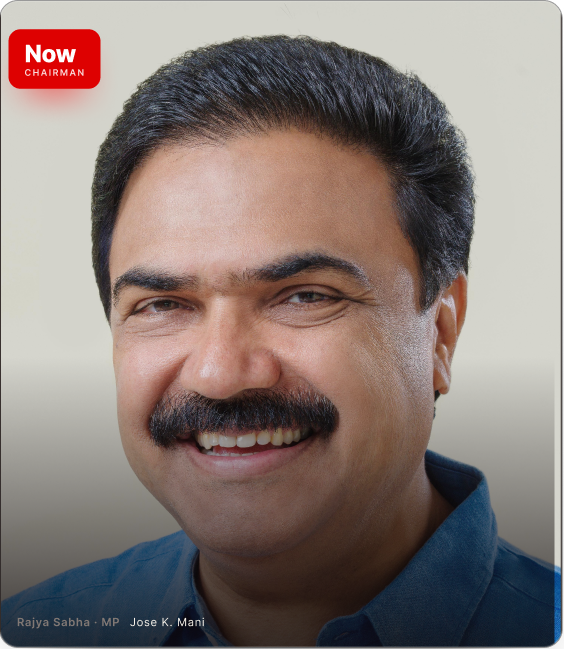
Jose K. Mani serves today as the Chairman of the Kerala Congress (M) and as a Member of the Rajya Sabha. He was previously elected to the Lok Sabha twice from Kottayam — in 2009 and 2014 — and has been entrusted by the State Committee with the work his father began at Charalkkunnu.
The party walks into its seventh decade with five MLAs in the Kerala Assembly, an MP in the Rajya Sabha, a Lok Sabha MP from Kottayam (Thomas Chazhikadan) and more than 480 elected representatives across panchayats, blocks and district panchayats — a presence that begins, as it always did, with the farmer at the village pump.
The full arc
A breakaway group declares a new party at Thirunakkara Maidan, Kottayam, inaugurated by Mannathu Padmanabhan.
K. M. Mani wins Pala for the new party — the first of thirteen consecutive victories.
The Adhwana Varga Sidhantham is presented at a party convention in Charalkkunnu, building on the 1973 Aluva Economic Resolution.
A faction split leaves K. M. Mani leading the 'M' formation on his own terms.
K. M. Mani presents a record 13 state budgets across successive UDF governments.
Closes 51 unbroken years in the Assembly and five decades leading the party.
The state committee meets at CMS Retreat Center, Kottayam, and confirms the succession.
The Election Commission rules in Jose K. Mani's favour; the Supreme Court upholds it.
After four decades with the UDF, Kerala Congress (M) realigns with the Left Democratic Front.
Five MLAs, a Rajya Sabha MP, a Lok Sabha MP and six frontal organisations carry the toiling-class idea forward.
Six decades on, the toiling class still needs a party that answers to it. Join a wing, raise a grievance, or simply read on.