
1933 – 2019 · Founder-leader, Kerala Congress (M)
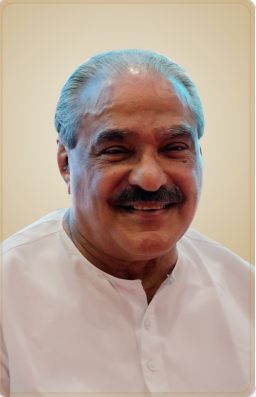
K. M. Mani — the steady centre of Kerala politics

30 January 1933 — 9 April 2019 · Pala, Kottayam district

50+ years legislator 13 budgets 13 Pala wins
K. M. Mani

Born in Pala · Lawyer · Statesman

The Man

Karingozhackal Mathew Mani — known simply as K. M. Mani across Kerala — was born on 30 January 1933 in Pala, Kottayam district. His father was K. T. Mani; his mother, Aliyamma. He studied law, built a practice as an advocate, and entered public life through the Kottayam District Congress Committee.

He married Kuttiyamma, a cousin of the veteran Congress leader P. T. Chacko. Together they had six children: five daughters — Elsa, Sally, Anie, Tessy and Smitha — and a son, Jose K. Mani, who today chairs the party his father founded.

Mani joined Kerala Congress in 1965 and was elected to the Legislative Assembly the same year from Pala — the first of thirteen consecutive wins from that constituency. In 1979, when the Kerala Congress fractured, he founded the Kerala Congress (M), giving the agrarian middle class of central Kerala its most enduring political platform.

FatherK. T. Mani
MotherAliyamma
SpouseKuttiyamma
Children6 (5 daughters + Jose K. Mani)
FaithSyro-Malabar Catholic
ProfessionAdvocate · Statesman

1965 – 2016 · 13 consecutive wins · Longest-serving MLA in Kerala history

The Pala Decades

1965 —

first win, Pala

1967
1970
1977
1980
1982
1987
1991
1996
2001
2006
2011
2016 —

final win, margin 4703 votes

51 years as a sitting MLA (1965–2016, until his death in April 2019). Never lost a single Assembly election in 13 contests. Kerala's longest unbroken legislative record.

Finance · Law · Welfare

The Finance Minister

K. M. Mani served as Finance Minister of Kerala across multiple governments, shaping the state's public finances for more than three decades. His command of fiscal policy earned him respect far beyond his own party.

13
State budgets presented

A record 13 budgets as Finance Minister — more than any other person in Kerala's history. Each budget reflected his deep knowledge of the state's fiscal architecture.

1980
–2015
Finance portfolio years

From his first Finance and Law ministry in 1980 under A. K. Antony through the Oommen Chandy II government, Mani shaped budgets across both UDF and earlier coalition governments.

Longest unbroken finance ministership in Kerala — his tenure across the Oommen Chandy II government (2011–2015) represented the most sustained stewardship of the Kerala exchequer in the state's post-1956 history.

Adhvana Varga Sidhantham · Political philosophy

The Theory of the Toiling Class

K. M. Mani's most original intellectual contribution — a deliberate counter to orthodox Marxist class theory that redrew the lines of Kerala's agrarian politics. First articulated at the Aluva Economic Resolution (1973); formally shaped at Charalkkunnu, 27–28 March 1978.

01 / 03
One working class

Farmers, agricultural workers, factory hands and salaried employees all belong to the same toiling class. Their interests are aligned, not opposed. Classifying small landowning farmers as 'exploiters' was, Mani argued, a fundamental error.

02 / 03
Two sides of one coin

A farmer and the worker on his field share the same dignity of labour. The party that fights for one must fight for the other. Mani's theory demanded that the political movement unite both — rather than pit them against each other.

03 / 03
Born at Charalkkunnu, 1978

K. M. Mani gave the theory its formal shape at the Kerala Congress state committee at Charalkkunnu on 27–28 March 1978, building on the 1973 Aluva Economic Resolution. The theory was so compelling that even the Left was eventually forced to bring farmers into its political fold.

The Theory of the Toiling Class

അധ്വാന വർഗ്ഗ സിദ്ധാന്തം

Download: Adhvana Varga Sidhantham (PDF)

† The theory was reportedly presented at the British Parliament — a rare honour for a regional Indian political thinker.

Flagship welfare scheme · Finance Minister's initiative

Karunya Benevolent Lottery

Launched by K. M. Mani while serving as Finance Minister, the Karunya Benevolent Lottery directs a portion of Kerala State Lottery revenue to fund medical treatment for poor patients with serious illnesses — kidney disease, cancer, heart conditions and brain ailments. It is one of the most direct welfare pipelines built through fiscal policy in Kerala's history, transforming lottery proceeds into life-saving care for the state's most vulnerable citizens.

Books, papers & downloads

The Author

Beyond politics, K. M. Mani was a writer and thinker. His books on Kerala's fiscal challenges, socialism and development planning remain valuable documents of mid-century economic thought.

Fiscal Problems of Kerala

Causes and Remedial Measures — a systematic analysis of Kerala's structural fiscal challenges and actionable prescriptions for reform.

The People's Socialism

Mani's vision of a humane, farmer-centered socialism rooted in Kerala's agrarian realities rather than imported ideology — the philosophical twin of the Toiling Class Theory.

The Eighth Five Year Plan — An Alternative Approach

A counter-proposal to the official plan, advocating for a decentralised, people-driven development model — ahead of its time in Kerala's planning discourse.

K. M. Mani — Coffee Table Book

Download PDF

അധ്വാന വർഗ്ഗ സിദ്ധാന്തം

Download PDF

A life in public service

Life Timeline

30 January 1933

Born in Pala

Born in Pala, Kottayam district. Trained and practised as a lawyer before entering public life.

1965

First elected to the Assembly

Wins Pala for Kerala Congress and enters the Kerala Legislative Assembly — the start of 51 unbroken years of representation.

1970s

Early economic groundwork

Lays the early economic arguments that would become the toiling-class theory, uniting farmers and wage-earners under one platform.

1979

Founds Kerala Congress (M)

Leads the 'M' faction into being, carrying forward the toiling-class platform under its own banner.

27–28 March 1978

Toiling Class Theory — Charalkkunnu

Formally presents the Adhwana Varga Sidhantham at a party convention in Charalkkunnu, building on the 1973 Aluva Economic Resolution.

1980

First budget presented

Presents his first state budget as Finance Minister of Kerala — the first of an eventual thirteen.

1990s

A setback, briefly out of office

Coalition realignments cost him the finance portfolio for a term — a setback he answers by rebuilding the party from Pala outward.

2016

13th Pala win

Wins Pala for the thirteenth and final consecutive time, by a margin of 4,703 votes — a record unmatched in the Kerala Assembly.

9 April 2019

K. M. Mani passes away

Passes away at Lakeshore Hospital, Kochi, closing five unbroken decades of public life and opening the succession that follows.

"There is one Kerala Congress in this country. That is our Kerala Congress (M)."
— K. M. MANI

Continue exploring

Read our full story

From the 1964 founding at Thirunakkara Maidan through 2020 LDF realignment — explore the complete Kerala Congress (M) narrative.